What Is Paintless Dent Repair? A Complete Guide for Arkansas Drivers
If you have ever walked out of a store to find a fresh door ding, or watched hail pepper your hood during an Ozarks spring storm, you have probably wondered: What is the best way to fix this without making it worse? The answer, for a wide range of dents, is paintless dent repair — commonly called PDR. It is the method we use every day at Harrison Dent Removal, and it is the reason we can return a damaged panel to factory condition in a matter of hours instead of days.
What Is PDR, Exactly?
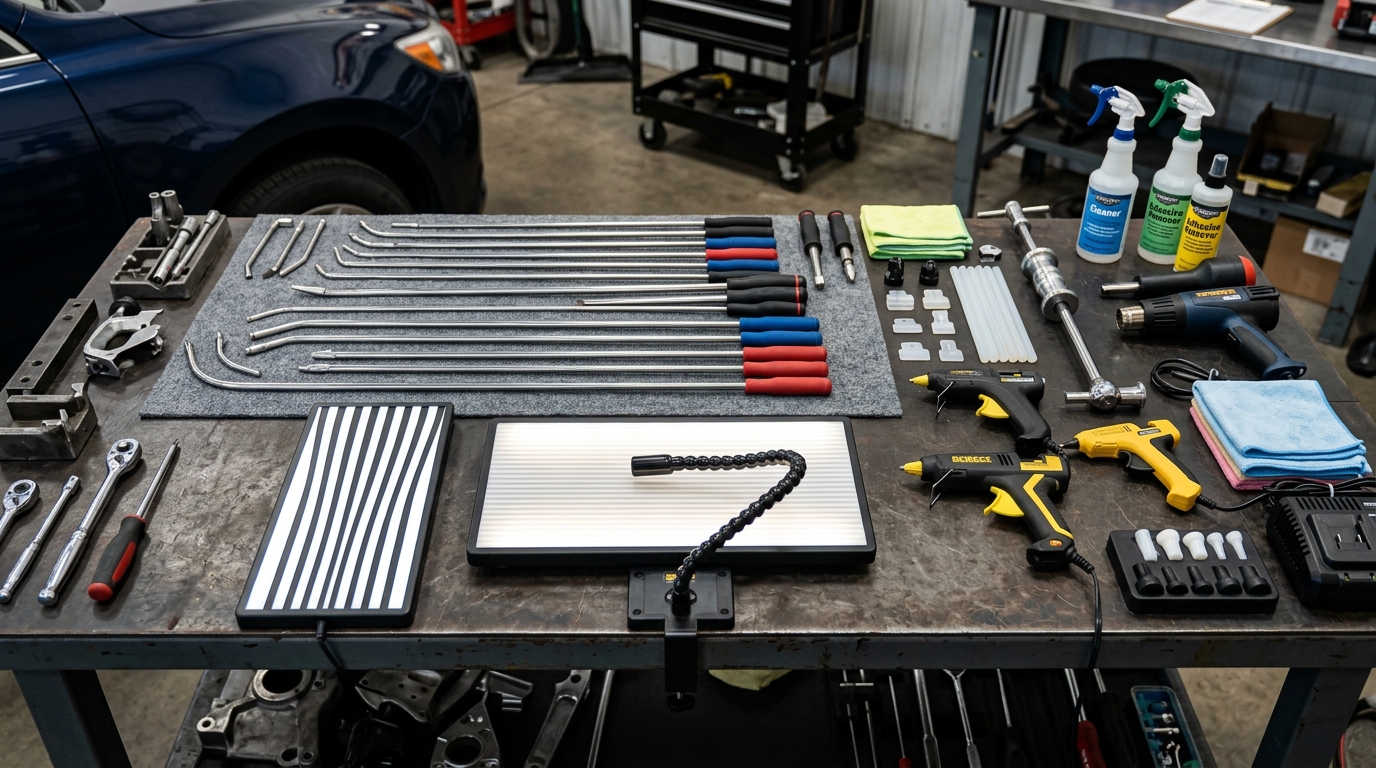
Paintless dent repair is a specialized technique that removes dents from vehicle panels without disturbing the original paint, filler, or clear coat. Instead of sanding, bonding, and repainting — the traditional body shop approach — a PDR technician accesses the backside of the damaged panel and uses precision metal rods to gently massage the metal back to its original shape.
For areas where backside access is impossible, such as some roof rails or double-walled panels, we use glue-pulling tabs. A specialized hot-melt adhesive attaches a small tab to the outer surface of the dent, and a pulling tool lifts the damage outward in controlled increments. Both methods rely on the same principle: the metal has a memory, and with the right pressure, temperature, and lighting, it can be coaxed back to exactly where it started.
How the Process Works
Every PDR repair at our Harrison shop follows a consistent process, whether it is a single door ding or a hail-catastrophe with hundreds of dents.
- Inspection under LED reflection boards. We place a specialized light board on the panel that casts sharp lines across the surface. Even a tiny distortion in the metal becomes visible, allowing us to map the full scope of the damage.
- Access strategy. We determine the safest entry point — often through window openings, inner door panels, or carefully removed trim pieces. In some cases, we use glue-pulling from the outside.
- Precision pushing or pulling. Using a variety of rod lengths, tip shapes, and glue-tab configurations, we work the dent from the edges inward. This prevents overstretching and preserves the paint.
- Quality check. We re-inspect under the light board, feel the surface by hand, and review the panel from multiple angles to make sure the repair is invisible.
Types of Dents PDR Fixes Best
PDR is not a magic wand, but it handles an impressive range of everyday damage. The ideal candidates include:
- Door dings and shopping cart dents: Shallow, round dents on flat or gently curved panels. These are the bread and butter of PDR and usually take 30 minutes to 2 hours.
- Hail damage: Hundreds of small dents across the hood, roof, and trunk. PDR is the industry-standard hail repair method because it preserves factory paint and avoids panel replacement.
- Minor creases: Sharp, linear dents from impacts along a door edge or fender line. These require more skill but are absolutely fixable with the right tools.
- Bumper dents: On metal bumpers, PDR can often restore the surface. Plastic bumpers require a different approach, which we also handle.
When PDR Is Not the Right Choice
Honesty matters in this business. There are cases where traditional body shop repair is the better option:
- Paint is cracked or chipped: PDR does not fix paint damage. If the clear coat is broken, repainting is necessary to prevent rust.
- Deep, stretched dents: If the metal has been stretched beyond its elastic limit, PDR cannot fully restore the panel.
- Damage on panel edges: Dents right at the edge of a door or fender are often inaccessible and may require traditional repair.
- Plastic panels: Bumpers and some fenders are plastic, which does not respond to PDR techniques.
Why PDR Is Better for Your Car's Value
Factory paint is applied in a controlled environment with precise temperature, humidity, and thickness standards. Once that paint is sanded and repainted — even by a skilled body shop — the panel is no longer "factory original." This matters when you sell or trade your vehicle. A Carfax report showing bodywork can reduce resale value by hundreds or thousands of dollars.
PDR preserves the original paint, which means no Carfax entry, no color-matching issues, and no risk of peeling clear coat down the road. It is the only repair method that makes the dent disappear while keeping the panel exactly as the manufacturer intended.
Cost Comparison: PDR vs. Body Shop
Finding a Qualified PDR Technician in Harrison, AR
Not all PDR techs are equal. The skill takes years to develop, and a bad PDR attempt can crack paint or stretch metal beyond recovery. Here is what to look for:
- Experience: Ask how many years they have been working and how many hail jobs they have done. Hail repair is the ultimate test of PDR skill.
- Before/after photos: A reputable tech should have a portfolio of repairs on cars similar to yours.
- Guarantee: Do they stand behind their work? At Harrison Dent Removal, every repair is satisfaction-guaranteed.
- Insurance relationships: If they regularly work with insurers, it is a sign of trust and documentation quality.
Ready to Get That Dent Fixed?
If you are in Harrison, Mountain Home, or anywhere in the Ozarks and you have a dent that needs to disappear, we are here. Text us a photo for a quick estimate, or stop by the shop for an in-person assessment. Most door dings are fixed while you wait.
Still Have Questions?
Call or text Jeff for a free damage assessment. No obligation, no pressure — just honest advice about whether PDR is right for your car.
Call Jeff: 870-365-5729